
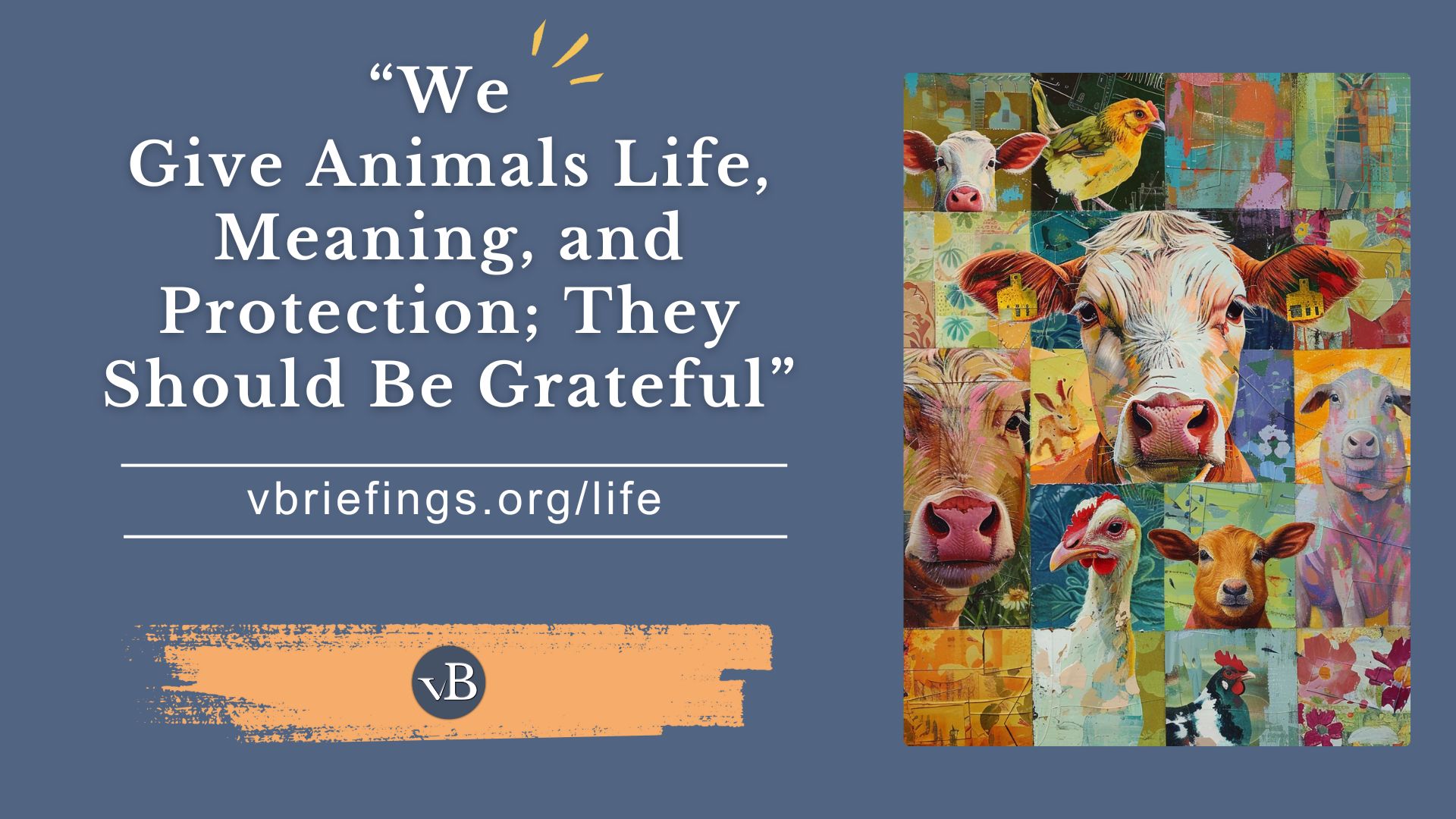
Respecting sentient life means fostering a compassionate world where animals live freely without harm. Instead of justifying their exploitation, we should honor their dignity and intrinsic worth. Farmed animals are bred for human benefit, facing suffering and premature death, while protections often prioritize human interests. Far from feeling gratitude, these animals endure lives of exploitation, highlighting the need to protect them from injustices at the hand of humans.
This briefing actually addresses a series of objections, not just one, for which each objection might be expressed alone or as a group.
This objection to veganism and animal ethics is often used to justify breeding, exploiting, and killing animals by reframing it as a form of benevolence.
These objections are usually made in the context of farmed animals that we breed into existence to provide food, but some in the series could also apply to any animal used for any purpose.
It is possible to honor life without contributing to a cycle of suffering.
Fostering a compassionate world where animals can live freely without harm is the right way to honor life. By promoting compassionate and sustainable lifestyles, we can honor life without causing unnecessary suffering.
Instead of justifying the suffering inherent in exploiting animals, the focus should be on respecting the dignity and well-being of animals, rather than breeding them into existence solely for human benefit, which inevitably leads to suffering and early death
Breeding disrespects life by undermining the inherent dignity and well-being of the animals.
It seems strange that breeding an animal into existence for our own selfish purposes, especially when it is known that the animal will endure suffering and be slaughtered while still young, would be considered a noble or altruistic act.
Such breeding does not honor life. Instead, it undermines the inherent dignity and well-being of the animals and subjects them to lives of suffering, confinement, and eventually slaughter.
Any protections we may provide are not for the animals—they are for production purposes.
We shouldn’t pretend that the protections we provide for farmed animals, from predators or other harms, are for the benefit of animals.
Any protections from predators and from the elements are to maximize profits and production, not because we are concerned for their well-being.
Because of their treatment and slaughter at a young age, it would seem they have more need to be protected from humans than by humans.
The idea that we give their lives meaning is an odd spin on the meaning of life.
The notion that we give their lives meaning is flawed, as animals possess their own intrinsic worth, independent of human utility.
It’s not as if the wisdom of Viktor Frankl1 were illuminating our collective psyche here. The suffering we force these innocent animals to endure cannot be rationalized away by invoking platitudes about the meaning of life.
- Note: Viktor Frankl wrote extensively about the search for meaning in life, emphasizing that finding purpose is essential to human existence.2
As Tom Regan says,3 animals “have a life of their own that is of importance to them, apart from their utility to us. They are not only in the world, they are aware of it and also of what happens to them. And what happens to them matters to them.”
It is unlikely a farmed animal would feel gratitude.
It’s disingenuous to suggest that the oppressed should be grateful to their oppressors.
Anyone considering the lives of farmed animals objectively, free from the fog of our cultural norms, would not think they should be grateful to us for the existence we force upon them just because we like to eat their flesh and secretions.
Why this objection to veganism and animal rights is speciesist
- The idea that farmed animals or other exploited animals owe humans a debt of gratitude for giving them life and protecting them from predators is inherently speciesist because it assumes that humans have the right to control the existence and conditions of other species solely for their own benefit.
- This viewpoint treats animals as commodities whose worth is defined by their utility to humans, ignoring their intrinsic value as sentient beings with their own interests. By framing animals as beneficiaries of human intervention, it dismisses the harm inflicted on them through breeding, confinement, and eventual slaughter, which are fundamentally at odds with their well-being.
- Moreover, the notion of gratitude presupposes a moral hierarchy where humans act as benevolent providers, erasing the reality of exploitation. In nature, animals live autonomous lives without “owing” anything to others for their existence.
- Applying a standard of gratitude to farm animals only reinforces an unequal relationship where humans take credit for creating lives that are ultimately controlled and ended on their terms. This perspective denies animals the dignity and agency they deserve, perpetuating a justification for their oppression rather than recognizing their right to live freely.
Other Resources
“Eating Animals: Debunking our Pastoral Myth” critiques the romanticized view of animal farming, exposing the realities of animal suffering and questioning the moral justifications for consuming animal products.
“What We Owe Animals: A Response to Christopher Tollefsen” critiques the view that animals are created as a gift for human use, advocating for a more ethical consideration of animal rights and autonomy.
“Justice for Animals: Our Collective Responsibility” by Martha C. Nussbaum discusses Nussbaum’s book, which argues for a capabilities approach to animal justice, emphasizing the need to allow animals to live flourishing lives free from human-imposed suffering.
Advocacy Notes
Tips for Advocacy and Outreach
General Tips
Understanding Your Goal
- Your goal isn’t to just prove them wrong but to help them see how flawed and speciesist this reasoning is. People who say this are not necessarily cruel—they are just repeating a narrative that makes them feel comfortable with the status quo.
Be Careful with Human Analogies
- If you bring up a comparison to human life, that might be perceived as denying the legitimacy of human parenting in less-than-ideal circumstances.
- Even if you avoid a comparison to humans, your interlocutor might make the comparison. If that happens, try to bring the focus back to the animals by saying “well, we are not addressing humans here—we’re talking about other animals.”
Segue the Conversation Back to Animal Ethics
Ask a question that can lead the conversation back to animal ethics.
- “If we truly cared about giving animals a good life, wouldn’t the best way be to let them live freely, rather than breeding them just to kill them?” Have you ever looked into what happens in farms and slaughterhouses?”
- “Are you not using this objection to justify breeding, exploiting, and killing animals by reframing it as a form of benevolence? Do you think what happens in farms and slaughterhouses is benevolent?”
Why? During conversations, it’s better to move the conversation to more specific injustices and suffering than to keep it focused on abstract concepts.
Show Them the Right Way to Honor Life
When we truly honor life, we seek to protect it from harm rather than using its existence as justification for exploitation.
- “Do you think that by promoting compassionate and sustainable lifestyles, we can honor life without causing unnecessary suffering?”
- “Would not fostering a compassionate world where animals can live freely without harm be the right way to honor life?”
Why? This reframes the conversation from abstract justifications to concrete ethical principles.
Reveal Their Flawed Logic
If giving someone life means we can control, harm, or kill them, where else would we apply that logic?
- “If parents ‘give life’ to their children, does that mean they have the right to exploit or harm them?”
- “If a dog breeder raises puppies only to sell them for experiments, should the puppies be ‘grateful’ just because they were given life?”
Why? This forces them to apply their logic consistently—which makes it obvious that “giving life” does not justify mistreatment.
Expose the Illusion of Protection
People claim farmed animals are protected from predators and the harshness of nature—but at what cost?
- “It’s true we protect them from other predators, but we end up killing them ourselves. So who protects them from us?”
- “We protect farmed animals from wolves, but we send them to a slaughterhouse instead. Does that sound like real protection?”
- “A prisoner is protected from car accidents and starvation, but would you trade places with them just because they have a roof over their head?”
Why? This helps them see that the so-called protection is actually just a way to control animals for human use.
Challenge the Idea That We Give Their Lives Meaning
Some people say that because farmed animals wouldn’t exist without us, their lives are meaningful only through human use.
- “Does a wild horse or a whale need humans to give their life meaning? Why assume that cows or pigs do?”
- “If someone bred dogs just to use them for labor and kill them young, would you say that gave their lives ‘meaning’?”
Why? This highlights how arrogant and speciesist it is to assume that animals need humans to create purpose for them.
Address the “But They Wouldn’t Exist Without Us” Argument
People often say, “If we didn’t farm them, they wouldn’t even be alive.” While true, this does not justify breeding animals into suffering.
- “If we bred people just to enslave them, would you say they should be ‘grateful’ because they got to exist?”
- “Bringing someone into existence only to exploit and kill them isn’t kindness—it’s control. Shouldn’t life be given for its own sake, not for profit?”
Why? This exposes the flaw in their logic by applying it to a different context.
Ask What Gratitude Would Even Look Like in This Situation
It’s absurd to think that farmed animals should be grateful for their circumstances. Make them question how that would even work.
- “How exactly would a pig express gratitude to the farmer—by willingly walking into the slaughterhouse?”
- “If you were given food and shelter but were forced into a short life of suffering, would you feel grateful or would you feel trapped?”
Why? This makes them recognize how ridiculous the ‘gratitude’ argument is.