
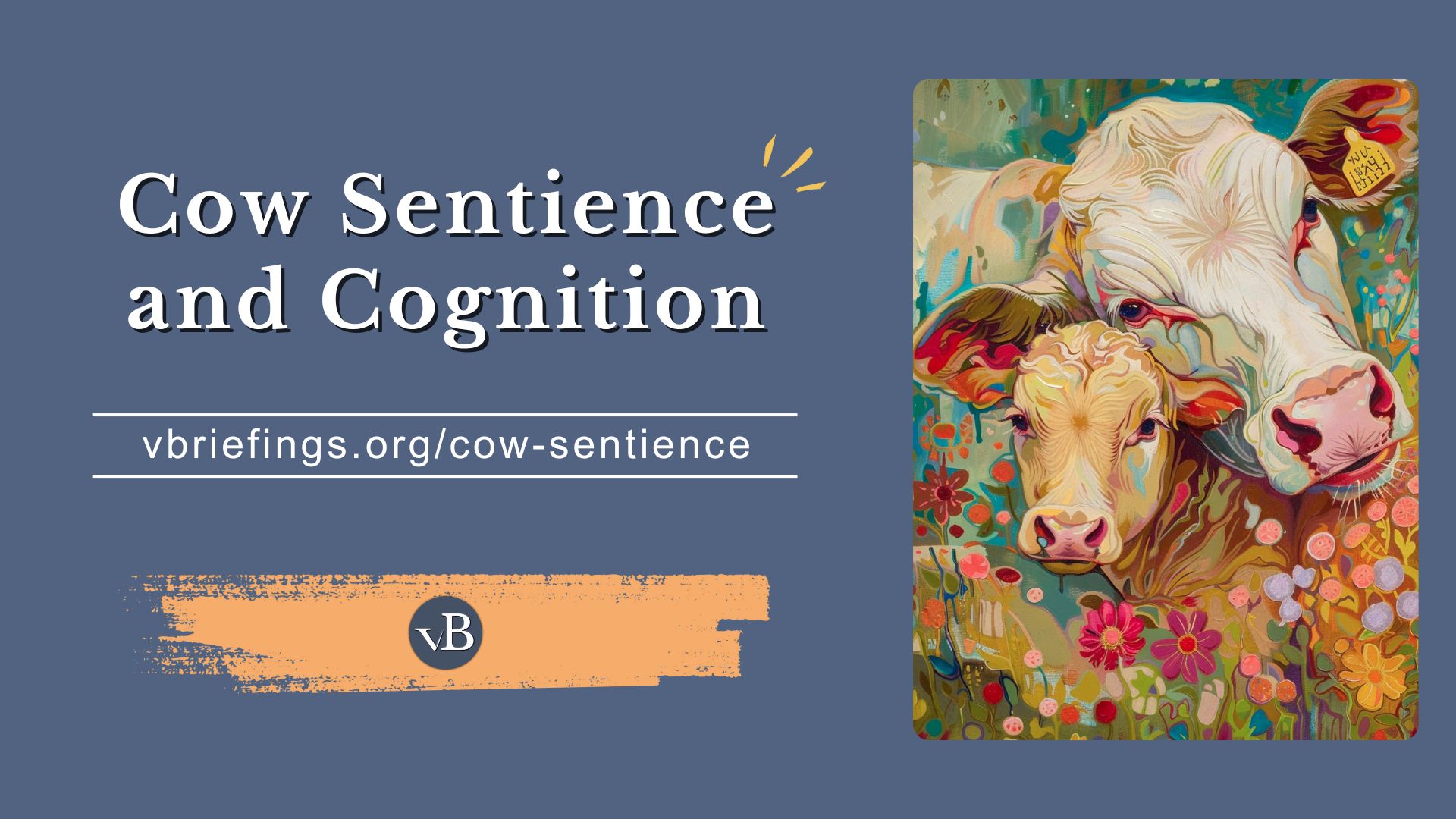
Cows are sentient beings capable of feeling pain, experiencing emotions, and forming deep social bonds, each with a distinct personality that reflects their individuality and emotional depth. They show fear and frustration in stressful situations but display joy through playful behavior and excitement in positive circumstances. With unique vocalizations and the ability to recognize individuals, they communicate in sophisticated ways and can pick up on the emotions of others. Their advanced cognition includes memory, spatial learning, and anticipation of future events.
Note: We use the word “cow” to mean both male and female of the species, unless used with a gender-revealing adjective.
Cows experience a wide range of emotions, including empathy.
Cows experience fear and anxiety in stressful situations, shown by behaviors such as escape attempts and vocalizations. They show signs of frustration when separated from their calves or shown food they cannot access. When gently petted, their visible eye white percentage decreases, a sign of positive emotional arousal. They also become more relaxed and their heart rates decrease.1
In one study, heifers showed signs of excitement after completing a task and receiving a reward, compared with a control group who received a reward without completing a task. This confirms that cows have self-awareness and that they enjoy achieving goals.2
Calves make more “pessimistic” decisions following a negative experience, showing that their emotional state affects their judgment. When cows are stressed, those nearby show signs of stress as well. This is evidence of emotional contagion, sometimes considered to be a basic form of empathy.3
Cows use complex communications with their own offspring and companions.
Cows use sophisticated object discrimination, including recognition of individuals.
Cows can discriminate between different geometric shapes, the same shapes in varying sizes, and stimuli in different sizes and levels of brightness.6
Cows can discriminate between different people, showing fear when they encounter those who have treated them roughly. They are even able to tell the difference between people who wear the same clothes. In one study, cows were able to learn which of their handlers would give them a food reward and learned to approach that handler more often. This shows their ability for associative learning.7
Cows are also able to discriminate between others of the same species, both those they are familiar with and strangers, and remember this information for at least twelve days. When shown photographs of familiar cows, they recognized them as representations of the individuals they knew. The cows immediately chose photographs of familiar cows over those of unfamiliar ones. This provides evidence that they store mental images of others. The fact that they can recognize others from photographs as well as in real life suggests that they have a “sophisticated visual discrimination capacity.”8
Cows have a sense of the past and the future.
In one study, a food trolley was slowly pushed along so that cows could follow and eat from it. The trolley was then pushed into a tunnel where the cows couldn’t see it. The cows successfully showed that they could extrapolate future movements by waiting at the other end of the tunnel for the food. This shows that they can anticipate the future and extrapolate it from the past.9
Cows possess long-term memory and are capable of spatial learning.
Cows are skilled at navigating mazes and are able to remember where the food was located in the mazes for as long as six weeks. In one study, cows learned to associate a plastic tub with food and still remembered this information a year later. A literature review concluded that cattle have “robust spatial memory abilities.”10
Individual cows have distinct personalities and preferences.
Cows have personalities. They respond differently to situations like being milked. Some cattle are more nervous, aggressive, or sociable than others.11
No counterclaims are addressed in this briefing.
None provided.
Other Resources
Study: The Psychology of Cows. (The Animal Behavior and Cognition Journal)
Video: How Sentient Are Animals, Really? (Youtube)
Advocacy Notes
Tips for Advocacy and Outreach
General Tips
Some may dismiss cows as simple, unintelligent animals, assuming they lack emotions or cognitive abilities. Your goal is to challenge these misconceptions, highlight scientific evidence of their intelligence and emotional depth, and encourage people to see cows as individuals deserving moral consideration.
Expose misconceptions. Many people underestimate cows simply because they’ve never considered their cognitive abilities.
Make it personal. Encourage them to think about how they judge intelligence and moral worth.
Reframe the conversation. The issue isn’t whether cows are as smart as humans—it’s whether they can suffer and have preferences, which they clearly do.
Shift the Focus from Intelligence to Sentience
People often believe intelligence determines moral worth, but what matters is the ability to suffer and experience emotions.
- “If intelligence determined moral worth, would that mean a highly intelligent person has more rights than someone with a cognitive disability?”
- “Since cows feel pain, experience emotions, and form relationships, doesn’t that mean their suffering should matter just as much as any other sentient being?”
Why? This reframes the issue by showing that sentience—not intelligence—is what truly matters in ethical discussions.
Challenge the Assumption That Cows Lack Emotions
People often assume cows don’t feel deeply. Show them that cows experience a wide range of emotions, from joy to fear to frustration.
- “If cows show signs of emotional distress when separated from their calves, doesn’t that indicate strong maternal bonds?”
- “What does it say about cows’ emotional depth when they show excitement after solving a problem, frustration when they are denied food, and relaxation when they are gently petted?”
Why? This forces them to acknowledge that cows have rich emotional lives.
Show That Cows Communicate in Complex Ways
Some may believe that cows lack meaningful communication, but they use unique vocalizations to express emotions and connect with others.
- “If cows recognize their own offspring’s calls and use specific vocalizations to ask for support, does that sound like a simple, mindless animal?”
- “Since cows have individual voices and maintain vocal identity across different situations, does that not suggest a higher level of social intelligence?”
Why? This highlights that cows communicate meaningfully, just as other socially intelligent animals do.
Reveal That Cows Recognize Individuals and Form Social Bonds
Some people think cows don’t form personal relationships. Show them that cows recognize and remember others, both human and animal.
- “Since cows can distinguish between different people, show fear toward those who treated them badly, and trust those who were kind, doesn’t that suggest they have memories and personal preferences?”
- “When cows recognize familiar herd members in photographs and prefer them over strangers, how does that change the way we see them?”
Why? This helps them see cows as individuals with meaningful relationships.
Show That Cows Have a Sense of the Future
People may assume cows live only in the present and lack the ability to anticipate events. Show them that cows can plan ahead.
- “If a cow can modify their behavior based on expected future rewards, doesn’t that suggest they have a mental timeline?”
Why? This challenges the belief that cows act only on instinct without forethought.
Demonstrate That Cows Have Long-Term Memory
Some believe cows forget things easily or lack complex memory. Show that they retain knowledge over long periods.
- “Since cows can remember the location of food in a maze for weeks and recall an associated object a year later, what does that say about their memory?”
- “How can we say cows are simple-minded when they display learning skills that rival those of many other intelligent animals?”
Why? This proves that cows have strong cognitive abilities that allow them to learn and remember over time.
Challenge the Idea That Cows Are Just Livestock, Not Individuals
Many people see cows only as a source of milk and meat. Show them that cows have distinct personalities.
- “Because some cows are naturally more nervous, aggressive, or sociable than others, wouldn’t that mean they have unique personalities just like humans and other animals?”
- “When cows react differently to situations like being milked, does that not suggest they have personal preferences and feelings?”
Why? This challenges the view that cows are just uniform, interchangeable farm animals.
Highlight That Cows Show Empathy and Emotional Contagion
Some assume cows don’t care about others. Show them that cows respond to the emotions of those around them.
- “If a cow becomes stressed when another cow is distressed, does that suggest empathy and emotional awareness?”
- “How can we dismiss cows as unfeeling when they show signs of emotional contagion, mirroring the emotions of their companions?”
Why? This reinforces that cows are socially aware and capable of empathy.
Expose the Contradiction in How We Treat Cows vs. Other Animals
People often value intelligence in some animals but ignore it in cows.
- “Since cows display problem-solving, memory, and learning skills similar to those of dogs, why do we protect one and exploit the other?”
- “If we recognize intelligence in animals like dolphins or primates, shouldn’t the same recognition apply to cows when they show similar abilities?”
Why? This pushes them to reconsider their inconsistent treatment of different species.
Leave Them With a Thought-Provoking Question
If they resist, don’t argue—leave them with something to consider.
- “Now that you know cows have memories, emotions, and social intelligence, does that change the way you see them?”
- “If we respect intelligence and emotional depth in other animals, why not in cows?”
Why? A strong question stays with them long after the conversation ends.
- Marino, Lori, and Kristin Allen. “The Psychology of Cows.” Animal Behavior and Cognition 4, no. 4 (November 1, 2017): 474–98. ↩︎
- Marino, Lori, and Kristin Allen. “The Psychology of Cows.” Animal Behavior and Cognition 4, no. 4 (November 1, 2017): 474–98. ↩︎
- Marino, Lori, and Kristin Allen. “The Psychology of Cows.” Animal Behavior and Cognition 4, no. 4 (November 1, 2017): 474–98. ↩︎
- de la Torre, Mónica, Elodie Briefer, Brad Ochocki, Alan McElligott, and Tom Reader. “Mother–Offspring Recognition via Contact Calls in Cattle, Bos Taurus.” Sentience Collection (April 1, 2016). Accessed January 29, 2020. ↩︎
- Green, Alexandra, Cameron Clark, Livio Favaro, Sabrina Lomax, and David Reby. “Vocal Individuality of Holstein-Friesian Cattle Is Maintained across Putatively Positive and Negative Farming Contexts.” Scientific Reports 9, no. 1 (December 5, 2019): 1–9. Accessed January 29, 2020. ↩︎
- Marino, Lori, and Kristin Allen. “The Psychology of Cows.” Animal Behavior and Cognition 4, no. 4 (November 1, 2017): 474–98. ↩︎
- Marino, Lori, and Kristin Allen. “The Psychology of Cows.” Animal Behavior and Cognition 4, no. 4 (November 1, 2017): 474–98. ↩︎
- Marino, Lori, and Kristin Allen. “The Psychology of Cows.” Animal Behavior and Cognition 4, no. 4 (November 1, 2017): 474–98. ↩︎
- Marino, Lori, and Kristin Allen. “The Psychology of Cows.” Animal Behavior and Cognition 4, no. 4 (November 1, 2017): 474–98. ↩︎
- Marino, Lori, and Kristin Allen. “The Psychology of Cows.” Animal Behavior and Cognition 4, no. 4 (November 1, 2017): 474–98. ↩︎
- Marino, Lori, and Kristin Allen. “The Psychology of Cows.” Animal Behavior and Cognition 4, no. 4 (November 1, 2017): 474–98. ↩︎